Contact me !

If you need to contact me , please write to me to this email ID : manjupadmasekar@yahoo.com. I will be happy to help.
Showing posts with label AFC. Show all posts

Tuesday, September 9, 2014

The much awaited fertilization report


Blastocysts which were frozen on day 6

Growth arrested embryos

This post is going to be easy for me. I will just copy and paste Dr. Sai’s emails.

On day 1, I had 15 embryos. I guess one egg matured in the lab, so there were totally 15 mature eggs out of 19 retrieved, and all were in the 2 PN stage on day 1. This means all ICSIed eggs fertilized, a 100% fertilization rate! This is just awesome and clearly shows the technical expertise of Dr. Sai.

The Day 2 gradings of your embryos are as follows:
2x 5-cell grade A
4x 3-Cell Grade A
6x 2-Cell Grade A
3 Embryos got arrested at 2pn Stage.

There are total 8 Top Quality Embryos on day 3.
Day 3 Grading is as follows:
5 x 8-cell grade A
3x 7-Cell Grade A
1x 6-Cell Grade A
1x 5-cell Grade A
3x 4-Cell Grade A

Day 4 Grading of your Embryos as follows:
3x MORULA
6X 8-CELL Grade A (COMPACTION OF CELLS SEEN)
.
2X 6-CELL Grade A
1X 4-CELL Grade C

Day 5 Grading of your embryos as follows:
1x blastocyst grade 1AA
1X EARLY BLASTOCYST
6X MORULA
2X 8-CELL Grade A 
1X 6-CELL Grade A
1X 4-CELL Grade C

Day 6 (One must keep in mind that, on day 1, fertilization of eggs were done during late evening!)

We are Freezing Total 6 Blastocysts today on day 6.

All morulae Stage Embryos have Become Blastocysts.

Although Exp Blastocyst in image Cap1020 doesn't have great Trophectoderm (the last blastocyst in the above collage) we are freezing it becauze it has got a good Inner Cell Mass.

Altogether I got 7 blastocysts out of 12 cleaving embryos, this means 50% blastocyst formation rate. This is  a great result ! Normally women below 35 years old can expect a blastocyst formation rate of 40%
I am already getting queries regarding how it was possible to get so many eggs. I have no clue too. My AMH was infact low but my AFC count was high. Honestly, I didn’t expect such a good outcome. But, I had lots of faith in Dr. Malpani’s team. Dr. Malpani designed the protocol, Dr. Anjali monitored me very closely and decided when to give the trigger shot, ofcourse, as always, she did a great job during egg retrieval, Dr. Sai was excellent in doing his part of the job and my ovaries cooperated too well! I didn’t take any supplements. Two and a half years ago, when I had my first IVF cycle with Dr. Malpani’s clinic I took DHEA 75mg for 6-7 months and I thought might be DHEA helped me to get many eggs. But this time I took nothing and I do understand now that DHEA might  not have contributed to the improved outcome previous cycle. My first five cycles which I had in Germany were terrible (http://myselfishgenes.blogspot.in/2012/05/my-ivf-journey-timeline.html). I was much younger at that time, had great AMH value, yet, I had only very few eggs to work with.In short, I am very thankful to God and to everyone who helped me to get 7 blastocysts. In the beginning, prognosis of this cycle looked very bleak, but it ended up much pleasant and successful than expected.
There were 6 blasts frozen on day 6. What happened to the remaining one? :) Was it transferred to Rita and what happened thereafter? Keep reading ! :)
Dr. Sai was kind enough to provide the pictures of embryos which got arrested during its development. I have given the pictures of blastocysts frozen on day 6 and the ones which stopped growing in the above collage.

Wednesday, October 2, 2013

Basic Infertility Workup Which Every Couple Struggling to Get Pregnant Must Do !


Please do a complete workup before starting treatment haphazardly!

You need to do ALL  the following simple medical tests:

Semen analysis for your husband ( to check his sperm count and motility). Read more at www.drmalpani.com/sperm.htm

Blood tests for you for the following reproductive hormones – FSH ( follicle-stimulating hormone),LH ( luteinizing hormone),PRL ( prolactin) , AMH ( antiMullerian hormone) and TSH ( thyroid stimulating hormone) on Day 3 of your cycle, ( to check the quality of your eggs). Do this from a reliable lab such as SRL ( http://www.srl.in/). Day 1 = Day the period starts.

HSG ( hysterosalpingogram, X-ray of the uterus and tubes, www.drmalpani.com/hsg.htm)  on Day 8 of your cycle ( to confirmYour fallopian tubes are open);

The vaginal ultrasound scan on Day 10-11 should check for the following. A. ovarian volume b. antral follicle count c. uterus morphology d. endometrial thickness and texture

Friday, June 7, 2013

What are antral follicles ?


Good ovarian reserve in a recombinant gonadotropinstimulated ovary studied with 3D. The use of orthogonal planes and 3D rendering allows a much better visualization of the antral follicles. This image shows the typical asynchrony. courtesy : jaypeejournals.com 

Antral follicles are small follicles ( ranging in size from 2-7 mm) which are present in your ovaries , and can be counted using a vaginal ultrasound scan during the earlier part of your menstrual cycle (day 2 –day 5). These are the follicles which develop in response to the FSH injections given during an IVF cycle. The number of antral follicles in your ovary gives a rough estimate of the number of eggs that will be retrieved from your ovaries  in the IVF cycle. The actual egg yield will also depend on the dosage of FSH used to stimulate your ovaries – and how well your doctor monitors your superovulation ! The greater the number of antral follicles , the greater will be the egg yield. A woman with a normal antral follicle count usually has good ovarian reserve and is more likely to produce a decent amount of eggs which are of good quality . This is why her chances of success with IVF are high too. Women with poor ovarian reserve tend to respond poorly to ovarian stimulation drugs , and their egg yield can be low. They have a poorer chance of success with IVF.

Thursday, April 18, 2013

Poor Ovarian Reserve


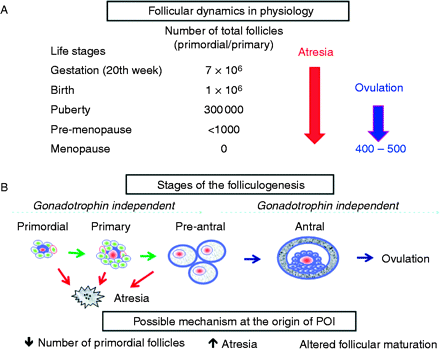
(A) Follicular dynamics and illustration of the folliculogenesis process in physiology. (B) The possible mechanisms generating POI may affect different stages of folliculogene © 2011 Society for Endocrinology
POI - Primary Ovarian Insufficiency or premature ovarian failure
What is poor ovarian reserve ?
Poor ovarian reserve or diminished ovarian reserve ( DOR) is a condition where the amount of eggs which have the potential to give rise to a healthy baby decline.  Most women develop poor ovarian reserve 6 to 8 years before reaching menopause. As women age, their ovarian reserve declines too. But there are some women who develop diminished ovarian reserve much earlier in their reproductive period and their ovarian age does not match their calendar age . In 90% of cases there is no explanation (idiopathic) why such premature ovarian aging happens.  But there are a few explanations for premature ovarian aging . These include :
  • Mutation in genes which codes for proteins that are involved in reproductive function
  • Autoimmune disorders
  • Certain viral infections
  • Chemotherapy or radiation exposure during cancer treatment
  • Surgery on the ovaries to remove cyst , or to remove endometriosis implants

How will I know whether I have poor ovarian reserve ?
There are three important tests which are routinely used in the field of ART for predicting a woman’s ovarian reserve :
1)      Measuring Anti-Müllerian Hormone levels (AMH) in blood
2)      Measuring FSH levels in blood
3)      Counting antral follicles (AFC count) present in your ovaries using vaginal ultrasound
These are very simple tests to perform and the information they provide is pretty accurate.  

How does poor ovarian reserve compromise IVF success ?
  • Women with poor ovarian reserve have fewer antral follicles in their ovaries. Antral follicles are the ones which grow in response to ovarian stimulation. This is why they produce fewer eggs when their ovaries are stimulated with gonodotropins (FSH and LH), which reduces their chances of IVF success .
  • Older women with poor ovarian reserve have poorer egg quality too. Older eggs are more prone to genetic errors , like aneuploidy. Embryos formed from these eggs either fail to implant or fail to achieve a healthy pregnancy.
I am diagnosed with poor ovarian reserve , will I be able to have my genetic child ?
Women with poor ovarian reserve have a poor prognosis with IVF treatment. However, younger women who are diagnosed with poor ovarian reserve have a better chance of success than their older counterparts. This is because these younger women still produce some eggs which are of good genetic quality. This means they produce fewer eggs , but the quality of their eggs is comparable to women of their age. This improves their chances of achieving a pregnancy and carrying a baby to term is high too. 

If you are diagnosed with poor ovarian reserve, it is wise to try one IVF cycle by stimulating your own ovaries , before deciding what to do. Remember, the final proof of your ovarian reserve status depends on how well you respond to ovarian stimulation during IVF. There are women who have very good AMH levels, and yet they respond poorly to ovarian stimulation - and vice versa. Theoretically, as long as you produce eggs, you have a chance of achieving a pregnancy.  During your IVF cycle, if your doctor finds that even with maximal stimulation, you are unable to produce a decent amount of eggs ; and  if those eggs give rise to very poor quality embryos, you may want to consider the option of using donor eggs. This is a decision only you can make !

Friday, April 12, 2013

How will I know whether I have a decent chance of success when pursuing IVF ?


When a clinic advertises that they have a  40-50% success rate per IVF cycle, it doesn’t mean this applies for every woman who undergoes IVF in that particular clinic. Even though it is hard to predict whether a woman will conceive in a particular IVF cycle or not, it is possible to calculate her chances of success , using certain parameters. The chance of achieving success depends on:
  • Age of the woman – younger you are greater are your chance of success !
  • Your ovarian reserve- If you have decent number of usable eggs left in your ovary, you are more likely to find success. Your ovarian reserve depends mostly on your age , but there are women who suffer from poor ovarian reserve at a young age as well .  How do you test your reserve ?
    1. Anti-müllerian hormone levels (AMH) in blood, measured on any day of your menstrual cycle. AMH is produced by the antral follicles which are present in your ovary.
    2. FSH and e2 levels in blood, measured on day 3 of your menstrual cycle
    3. Antral Follicle Count (AFC) scanning your ovaries using a vaginal ultrasound probe on day 1-5 of your menstrual cycle will allow your doctor to count the follicles which are between 2-7 mm is size. These follicles are called as antral follicles. The higher your antral follicle count, the better your ovarian reserve, because these are follicles which will grow when you are superovulated.

  •      A healthy uterus which is able to develop good endometrial lining  !
Related Posts Plugin for WordPress, Blogger...